Acceptance, strategy, and trust: learn how these three keywords come together to define Maria's experience as a Social Media Coordinator at arculus.
Hey Maria, welcome to our interview! First things first: can you explain what are your main tasks as a Social Media Coordinator at arculus?
I'm actually responsible for taking care of arculus presence online. That includes our social media channels, of course, like LinkedIn and Instagram. But also our online presence in general, our website and our blog as well.
My goal is to make sure that as many people as possible get to know who arculus is, what we stand for, what we do, and who we are. That includes potential customers but also potential joiners for our team.
When people think of a social media coordinator or manager, they usually think of someone who spends all day on Instagram or TikTok. But the job is actually much more than that, I get to think strategically, and I need a lot of organizational skills, but in the end, I really like what I do.
Focused at work
And what do you appreciate most about working at arculus?
First of all, being an immigrant in Germany, for me, it's really important to actually get to know more people, and everyone at arculus has been so nice to me so far. And all of the social events are also a great plus.
But also, as a member of the LGBTQ community, it feels amazing to be able to bring my full self to work, not having to hide a part of me. That makes waking up and going to work much easier every day. And, of course, the work-life balance is also a great plus for me. Being able to take care of myself outside of work as well, and this whole combination of things makes it easier and makes me feel good working here.
What arculus value do you most identify with?
Definitely trust. It's really good to know that I'm trusted to do the job I was hired for. So no one is really questioning my decisions towards what I think is better to fulfil our strategy and my tasks. And also, relating to time management, there's no one really checking how many hours you're working. No one really cares as long as you deliver what you're supposed to. And that's really different from what I have experienced so far in other companies.
Maria at the Werksviertel, where the arculus office is located
And one last question: what excites you the most about the Jungheinrich acquisition?
I actually come from quite a strong corporate background. So, for me, it feels a bit like "going back home". I really appreciate how these big companies have people all over the world who are working towards the same goal, so you actually get to meet people from different cultures and understand how they work. And, of course, the safety that comes with a big corporate job is also a nice bonus.
New hires are sometimes nervous or hesitant to address concerns and ask for assistance. There is some amount of stress which is natural yet overwhelming. That is where our six-month Buddy Program comes in - to facilitate integration through a social approach. This article will cast light on the process, its benefits to the team, and its guidelines, all from the perspective of arculus employees.
The buddy program is an onboarding initiative to familiarize new joiners with the company's culture, processes, standard protocols, and policies with the help of experienced colleagues. The program has been in place since 2020, thanks to the efforts of the arculus People's team.
“The aim is cross-functional development, enrichment of the employee experience, and good integration of recruits within different teams.”
Our buddies are always excited to welcome new joiners
How does the initiative work?
It is a six-month voluntary program, which requires a minimum of three meetings with half an hour each. Participants are free to hold sessions anywhere; it can be on the office premises, outside, or even online (depending on the location of both participants). "Most of the time, I am in the Gaimersheim office and only a few times in Munich. That's why I have had almost all of my buddy meetings online. But once, when we were both in the same city, we finally got to meet and talk over lunch.", explains Jonas Jaeger (Production Engineer).
The people's team takes three factors into account when selecting buddies. The first is if, after the end of their probation period, the employee wants to volunteer for the program. The second is to ensure that the participants are not in the same team so that the new joiner gets as comfortable with other groups as they would be with their usual peers. It also opens avenues to learn and understand what other departments are working on. The third is if the new employee works totally remotely, then they must get a buddy who works from the office. That allows them to see how everything is done at the workplace without feeling left out.
The program has no formal template to follow, and the meetings generally occur in an informal setting. "For me, it's always a casual meeting where we introduce ourselves. I explain a bit about the company, who is who, and my own experiences. It is also an opportunity to get more familiar with the other person.", describes Lisa Bell (Content Creator).
The idea is to lend ears and shoulders to the new colleagues; therefore, there are no final goodbyes. "In theory, your job is done after six months, at the end of your peer's probation period. But, for me, it is not a job; I see it more like being there and supporting that person," says Maria Souza (Social Media Coordinator). "You can for sure meet and talk as often after it ends.", adds Lisa.
Fabian Na and Lisa Bell having a good laugh in one of their buddy meetings
Nonetheless, participants need to keep certain principles in mind. As someone's buddy, one is not supposed to review the job performance, be a subject matter expert, or be expected to know everything. Buddies should offer encouragement and support, give honest feedback, provide suggestions for more efficiency and productivity, and keep the shared information confidential.
What makes the buddy program a symbiotic relationship?
Maria recalls how the buddy program facilitated her transition when she joined the team in January 2022. "It was nice to have someone to explain how arculus works and give me a positive outlook regarding what awaited me at this job."
Fabian Na (Mechanical Engineer) reminisces how this program gave him his point of contact in the company. "My buddy made me feel comfortable and introduced me to everyone. She also gave me a little background on what had happened in the company so far and explained a bit about the arculus culture."
Nevertheless, Fabian also believes it is an equal opportunity for the buddy to learn something new. "Now, being a buddy myself, I understand the company's culture better. Also, I get to give them information on how the company is and get to know that person better, especially if they're in a different department."
The buddies are active listeners
Like Fabian, Lisa finds the program a medium for connecting with other teams. "I'm always curious about what's happening in the other departments. What are they working on now, and what are their challenges? It also allows me to understand our products better as they continuously develop."
Reasons why our employees approve of it
Based on an internal company survey, arculus has received a positive response from the employees. They agree that this program helped them achieve a smoother onboarding process, better understand how other departments in the company function, and develop soft skills like networking.
"You develop many more connections in cross-functional teams. Without the program, many colleagues wouldn't have a clear vision of how processes work in other departments, or even what they're working on. Now, thanks to this creative initiative, we all have a much better understanding of the roles and responsibilities of the other colleagues."
Lisa Bell, Content Creator
TL;DR
The buddy program, in a nutshell, is a low-maintenance solution that has helped new joiners at arculus with integration. It provides them with a safe space and time to learn about the company culture, values, and operations through an experienced fellow worker. By combining it with other social and technical integration and onboarding initiatives, we provide possibilities for engaging with colleagues and improving knowledge about the company as a whole. As a result, we have well-informed and motivated employees with higher productivity rates right at the end of their onboarding process.
Rising labour expenses, workplace safety, labour availability, and a growing desire for speedy order fulfilment; these are all driving forces behind the warehouse automation trend. Now, with more distribution centres turning to robotics, intralogistics centres that don’t invest in technological development will be left behind when it comes to efficiency.
We've compiled a list of 9 intriguing stats about the dynamics of warehouse automation to show you why now is the time to invest. From space optimisation to increased accuracy, these stats demonstrate why the future of warehousing has already begun.
General Market Stats
1. The Autonomous Mobile Robot (AMR) Market size was valued at USD 1.61 billion in 2021 and is predicted to reach USD 22.15 billion by 2030
This accounts for a projected CAGR (Compound Annual Growth Rate) of 34.3% from 2022 until 2030. The ever-increasing use of these robots across various industries is largely due to their capacity to navigate independently in dynamic environments. Furthermore, the rising use of automated material handling and trends such as lights-out automation are likely to drive market expansion during the projection period. (Source)
Our arculee transporting pallets
2. The investment in intralogistics robotics is increasing
According to Logistics Management research, 10% said that they currently use AMRs or AGVs, and 23% are evaluating them for use within the next 24 months. Last year, that breakdown was 6% who currently use, and 14% considering them. “The simplest way to describe the overall findings from this year’s 'Annual Warehouse and Distribution Center (DC) Equipment Survey' is that it’s “go-time” for investment in warehouse automation.” (Source)
Does your company currently use, or are you considering, automated guided vehicles and/or robotics technologies for materials handling applications?
Source: Logistics Management, all rights reserved
3. 96% of industry leaders consider innovation essential for growth
Deloitte’s study defines innovation as an understanding of how the investment in it will pay for itself over time. It also explains that supply chain leaders know that “innovation is necessary if a company wants to shift the trade-offs between service levels and costs, rather than simply move along the curve.” (Source)
4. The top 3 areas for using robots in warehouses today are picking, goods receiving and unloading, and sorting
The study conducted by Peerless Research Group (PRG) in March 2022 shows that “the top priorities for using such technology includes picking (42.9%), goods receiving and unloading (42.9%) and sorting (37.5%). About 43% of companies are considering AMR pallet movement equipment while 34% want autonomous retrieval-to-person/put-wall robots, and 30.2% are evaluating robotic picking systems.” (Source)
Optimization Stats
5. Travel time in a warehouse can account for up to 50% of the picking time
Without automated solutions, workers must manually pick orders by hand and carry them across the intralogistics facility. With our goods-to-person robotics solution, picking efficiency can be increased two-fold. (Source)
6. Robot’s contribution to labour productivity in the 90s and 00s was about 0.35% per year
While that doesn’t seem much, specialists explain that it is comparable to the growth brought about by the steam engine during the years 1850 to 1910. Now, with technology reaching new higher standards, this number is likely to increase further. (Source)
7. 79% of organisations with better supply chain capabilities, the so-called “supply chain leaders”, achieve above-average revenue growth
Deloitte surveyed more than 400 executives in manufacturing and retail across the globe and found that superior supply chain capabilities tend to translate into above-average performance on revenue growth and EBIT (Earnings before interest and taxes) measures when compared to the industry average. (Source)
8. Warehouses are now nearly 3 times as large as they were 15 years ago
“The average size of warehouse in 2000 was about 65,000 sqft, whereas now it is over 181,370 sqft. As warehouses demand more space, this naturally pushes up the price. In fact, between 2011 and 2015, warehouse rental rates were up by a whopping 28%”, states a Westernacher Consulting report. According to the same research, increasing land costs are also one of the main drivers for intralogistics automation. (Source)
3D rendering of a warehouse with optimised space use
9. Automated and efficient warehouses are 76% more likely to boost inventory accuracy to 99% or higher
The survey conducted by Aberdeen Group with over 250 supply chain executives also shows that with “Systems assisting humans, rather than humans directing systems, best-in-class distribution centres are also able to achieve 95% on-time deliveries, one and a half times more often than average.” (Source)
Wind Up
The numbers don’t lie, the automated future has begun. But fear not; there is still time to join the race towards more efficient intralogistics. If you are ready to get our arculees up and running in your warehouse, head to Jungheinrich’s product page for a personalised solution consultation.
This is part 2 of the arculee story. If you haven’t yet read part 1, check it out here.
Fabian Rutsischka (Managing Director), Max Stähr (Head of Robotics Development), and Tobias Fink (former employee) testing the arculee 1.0
Two Sides of The Same Coin
With the arculee in hand, Audi not only backed up arculus’ vision but also became the first customer for the arculee 1.0. According to Fabian, with the trust and visibility of “a big and strong client,” the AMR received the push it needed to succeed in intralogistics. For him, this is one of the reasons for the arculee’s success.
Nonetheless, it also impacted the robot’s development in different ways. “Audi already had a project in planning that fit the idea of what arculus wanted to build”, explains Marius. The high expectations of a robust Original Equipment Manufacturer (OEM) guided the flexibility and scalability of the product from the beginning of its development. So we had to develop a safe and solid solution for a global player that also strictly met European standards and directives.
Hannes Bell (Project Manager) adds that the initial design of the arculee was iterated several times to meet the requirements of Audi’s facilities. “The size of the AMR; the width, length, and height were then defined by the trolleys that Audi was using in their facilities to carry containers. So the goal was to build a robot that could fit underneath those trolleys to carry them around”.
Our AMRs at the Audi facility
For six years, the initial concept has remained the same. “I think a large part of the initial assumptions we had back in those days about robots or fleet management are still intact and focused”, says Fabian. Now, with the acquisition of arculus by Jungheinrich in 2021, the arculee has become even more intralogistics-centric.
The New AMR Era
The applications of arculee have also evolved. For example, the earliest idea of the AMR came from the trolley-based application, and its design required a low height. However, the design and tallness were then customized for the first project – Supermarket 2.0 – which aimed to improve the overall commissioning process in the Audi supermarkets. “The basic idea of the robot is still that it is carrying something on top.”, explains Hannes. “But, of course, in terms of assembly, quality, and functionality, it has improved a lot since the first version”, he adds.
The development of the arculee over these years has taught many lessons. “The devil is in the detail” is how Marius sums it up. For him, there is no room for error. But if it happens, it needs to be fixed at an early stage. This means keeping the product and the process simple and robust to ultimately reduce the chances of system failures due to complexity.
"If you make an error you can not detect in the beginning, the impact is bigger. Therefore, it's good to have proper concepts, talk about them with everyone, and let them thoroughly review those concepts. Try not to make the next generation or the next version of a robot until the mistakes are fixed”.
Marius Leffler
Like Marius, Fabian explains that mastering different layers allowed them to react sooner to situations. “You’re responsible for everything. If anything fails, then it’s your fault. But on the other hand, you can react much faster because you don’t need to try to understand what others might have thought when designing”, he explains.
Here and now
Today the arculee evolved to the next generation, internally called Version 2.0, which is, in fact, more than just a product. The arculee is developed from the core like a platform based on all the developments we have done since 2016. We can now build the robot in different forms in a shorter time frame. “Now, if we want to build robots that can carry a larger load, let’s say two and a half tonnes, we can do that in a shorter time … because we already have the technology for that. It’s just a matter of building mechanics, putting in place the existing electronics, and scaling it”, expresses Iuri Ferreira (Senior Software Engineer).
With every new arculee shipped, the customer also receives a highly integrated and connected driving computing power with a lot of sensors. The team around Max Stähr (Head of Robotics) is able to add new functionalities to the robot, even if it is already on-site. Enabled through a proprietary OTA infrastructure, every arculee can grow in its functionality over time. With each new customer project, the functions team gathers new insights and data from the field. They can then use these data to develop or improve new functions.
Anika started her journey as a working student at arculus in February 2021. She initially supported the procurement of prototypes. Today, Anika is writing her Master’s thesis while also assisting her team with the series production for our Autonomous Mobile Robot (AMR). In this article, she talks about her experience with arculus.
Hey Anika! Please tell us a bit about yourself.
Anika: “I had always dreamed of becoming a dentist. However, as a professional sailing athlete, it was difficult for me to commit full attention to medical studies. That’s why I decided to pursue my degree in Business Engineering, which is also quite cool. Currently, I am writing my Master’s thesis on production and mounting systems.”
Anika during the arculus summer party in 2021
How do you recall your initial days at arculus?
Anika: “They were informative, yet not overwhelming. I had a million questions when I started, but they annoyed none of my team members. My colleagues were considerate and helped me get into everything faster than I thought, including processes, projects, protocols, etc.”
So, how would you say the work-study balance at arculus is?
Anika: “Initially, I couldn’t find the right balance between work and studies. I was too excited about my tasks at arculus. But if it weren’t for my team members and manager, who constantly reminded me to prioritize my studies and exams, I wouldn’t have made it this far. I think 20hr/week and studies are easily manageable together. It’s important to set priorities to find the right balance.”
As you said, your team encouraged you to focus on your studies. Was it the same with your work as well? How would you further describe your experience with them?
Anika: “In the beginning, I worked in the mechanics' department. The team was very diverse. It had different characters, each having unique perspectives. It was interesting to work together, as we were always striving to find new solutions.”
So, what makes your work experience at arculus different from your previous student jobs/internships?
Anika: “I think the key difference is that I am able to express my opinions. I have actively participated in all discussions and shared my viewpoints. Another difference is the freedom to work independently within a team. Also, flexible hours are a plus point here. I can choose my work hours based on my schedule, which reduces my stress.”
Anika working at our Munich Office
What is the most important thing that you have learned at arculus?
Anika: “arculus has taught me that work and social activities can go together. I will look forward to this when applying for a full-time role. Another important learning is that different perspectives in a team always generate better solutions.”
Last but not least, any recommendations for students who want to apply for a job at arculus?
Anika: “Join arculus (laughs). No seriously! Try to connect as much as possible. And most importantly, seek all the information you can get.”
Looking to develop new skills that go hand-in-hand with your study program? Apply here!
His head's in the cloud, but his feet are certainly on the ground. This is the story about arculus System Administrator and tech enthusiast Rudolph Maritz.
Hi Rudolph, welcome to our Voices of the Team series! Let's start with the basics: how did you first hear about arculus?
I was browsing on LinkedIn, and a position from arculus appeared as a recommendation matching my profile. So, out of curiosity, I decided to have a look into it, and I also read a bit more about arculus. It really sparked my interest, so I decided to give it a shot with my application. And, well, now I can say that it worked out really well.
What do you enjoy most about your job?
What I like about my job is that not a single day is the same. We have a lot of fun projects coming our way all the time, so, in short, it never gets boring.
Also, most of the projects are challenging, which allows you to think a little bit outside of the box, and it really motivates you to grow in your position and read more about different technologies. On top of that, you can create your own projects, which empowers you to take ownership of the work, while also making you feel proud of what you have accomplished.
Rudolph and a colleague in the Munich office
What is the biggest challenge you have faced here so far?
By far the cloud migration project. It took a while to complete, but it was totally worth the time and effort from start to finish, and I'm very very happy with the results.
So, in essence, just to explain it, we moved a lot of our internal services to the cloud, and a lot of it was quite challenging. But it made me really happy to complete the project and just see how smooth everything is running now.
Where do you see yourself next year?
Next year I see myself even more focused on the cloud, but also on the DevOps area in the software team. I mean, I've always been fascinated by Cloud Technologies, how it's changing the world and the challenges that it brings. And, as I said before, arculus offers a lot of room for growth, so I'll definitely try to continue embracing that as well.
Every product has a story of its own, and so does the arculee. This article will take you back eight years to how it all started: the concept, the team, and the struggles. It will walk you through different phases of our robot’s development and show you how it evolved from an initial idea to what it is today, all through the eyes of people who were part of this journey. From the flashbacks to the future plans – here is how our autonomous mobile robot has become an integral part of Intralogistics 4.0.
As you can probably tell by now, the name arculee derives from the company name – arculus, which in Latin means a bow or curve. The true inspiration is, however, the coiled cloth that head porters back in the day would wear to carry goods, also called arculus. “It was a unique and versatile means of transport, whether for food, water, or even wood for the fire. We then realized that it was quite a good analogy for what we had in mind", explains Fabian Rusitschka (Managing Director, arculus).
arculee, the Autonomous Mobile Robot, was initially a concept that emerged from the automotive production system in 2014. The team tested the idea via software simulations multiple times, only to confirm that it had the potential to truly make a difference in intralogistics. Fabian, the man behind this idea, was keen to shape his vision.
“I had to make a difficult call: either leaving it as a PowerPoint concept or quitting my job and finding the right people to build what I had envisioned”.
Fabian Rusitschka
The Show Must Go On
Two years later, in April 2016, Fabian founded arculus together with Frank Hempel (Head of Software Technology) and Marius Leffler (Senior Robotics Engineer). The initial step was the diagnosis of the software, robotics, and physical means of transport needed to develop a robot. From there, the concept began to evolve as a product.
The founding team of arculus (From left to right: Frank Hempel, Fabian Rusitschka, and Marius Leffler)
The idea won the support of Audi’s Technology and Innovation Management, with whom we signed our first development contract. From approving the first proof of concept to being involved in every step of building the robot, Audi was closely connected with us and was thrilled to witness Modular Production come to life.
To accomplish this, the team decided to build the brain (control system that manages the behaviour), install it inside a robot sourced from other vendors, and control it with fleet management software. Despite successful demos, the robots soon started encountering integration problems. “When you would tell the robot to go straight, it would steer to the left or right”, recalls Marius.
Overcome and Adapt
After a couple of months, the founders realized that it was not the right way to go about it. Thus, the focus shifted to building the robot from scratch.
“If we could fix all the problems and issues we had with the sourced robots, we might as well build our own robot… because then we could learn a little bit more, become more flexible, time and hardware wise, and also have the full stack in hand”
Marius Leffler
This was the first and most significant strategic move, according to Fabian. As we were heavily relying on other vendors, the primary motivation was to be a complete supplier of AMRs and become independent in terms of delivering quickly. The team also firmly believed that to build a vertically integrated product, it was essential to understand and influence all levels. “This helped us quite a lot over the years… that we mastered different fields from mechanical and electrical engineering to writing the embedded code. It helped us move and adapt to new situations”.
In early 2017, the plan was implemented, and we started building our first robot. Marius precisely remembers that on Valentine’s day that year, they had a prototype that moved. He recalls, “We threw in some surplus batteries. We had two motor drivers, my laptop that we threw into a chassis we had, with a couple of wheels that we formed manually…. and it was driven using an Xbox controller”. The team then built several prototypes until we had our own AMR ready in 2018. That’s when the arculee was born.
Alexandra Boblov is the newest addition to the software team. She is a UX/UI designer working on the front-end development of arculus software. Her role is to ensure the overall user experience on the software is accessible, enjoyable and usable. This article is about her experience with us as a working student.
Hi Alexandra. Please tell us a little bit about yourself!
Alexandra: “I am currently pursuing a Bachelor’s Degree in Visual and Communication Design at the Hochschule Pforzheim. It is similar to graphic design but in a wider context. It includes, for example, UI/UX, which is what I do here at arculus."
Alexandra working on one of her designs
What did you think of our onboarding process?
Alexandra: “The onboarding process allowed me to learn about the company processes much faster. It also introduced me to everyone at arculus who offered their support, even if we were in different teams. Altogether, it truly helped me settle down faster.”
And how is the work-study life balance at arculus for you?
Alexandra: “I have a fixed schedule for work and studies, which I set with my manager when I started at the job. So I work at arculus on Mondays and Fridays and keep the remaining three days only for university. It gives me enough time to focus on my studies without compromising my work quality. I feel this works well for me.”
So how would you describe your experience so far in your team?
Alexandra: “It is good so far. All of my team members work from different cities. Therefore, we have an online team meeting every morning. I like to hear and know what others are doing. I believe it boosts our team spirit and keeps us connected.”
What makes your work experience at arculus different from your previous student jobs/internships?
Alexandra: “Compared to the agency I was working for before, I find arculus more structured. Everyone is approachable and willing to help. What I love the most about arculus is the company channels for extracurricular activities. Recently, the team planned a hiking trip to Zugspitze. I couldn’t participate, unfortunately, but the pictures were so cool. I will definitely try to join the next one.”
Sounds cool! And how do you believe your work at arculus contributes to your learning process?
Alexandra: “Usually, at the university, we only learn concepts and theories. However, without practical experience, it has no value. My responsibilities at arculus are training me to become more effective, fast, and precise at UI/UX.”
And what is the most important thing you’ve learned so far?
Alexandra: “Every day at arculus is a new learning experience. If I have to pick the most important one, it is creating clean designs. With private or academic projects, the designs tend to be more cluttered or not primarily focused on customer needs.”
Alexandra at the arculus summer party in June
Last but not least, do you have any recommendations for future applicants who want to apply for a job at arculus?
Alexandra: “Believe in yourself. I was quite nervous when I applied for this student job. I thought I wouldn’t hear back from arculus due to the number of applicants for this position. But here I am! So go for it.”
Looking for a student job? We are hiring! Apply here.
When looking at a robot performing the tasks it was designed to do, it’s easy to overlook the meticulous electronic work that goes into it. For the arculee, the very core of this delicate craftsmanship is in its Robot Control Unit (RCU®). In this blog post, the engineer – or electronic artisan – Tobias Schwering takes you through his challenging journey of designing custom inverters. From theoretical investigations to the perfect Infineon Chips: this is an arculus electronics store.
How it started
When I started working at arculus as an electronics hardware engineer, one of my very first tasks was to revise our triple motor inverter, one of the key parts of our Robot Control Unit (RCU®). This is the very heart of our electronics system and the interface to the “muscles” of the arculee, the three permanent magnet synchronous motors we use for driving and lifting loads. It was a hugely interesting but pretty challenging task, especially given that I only had previous experience with simpler power electronics – even the strongest components I had ever designed had roughly only 10% of the power of one of our inverters.
A closer view of our RCU®, which features Infineon chips in its structure
At this time, the concept of the RCU as a single Printed Circuit Board (PCB) system, including nearly all the non-safety-relevant functions of our robot, was already laid out, and arculus was fully committed to developing its own power electronics. We even had the first few samples designed and produced by an external contractor – the only problem being that they didn’t work. These inverters delivered only a fraction of the necessary power and regularly died without warning. Furthermore, the team had no real consensus on why this was the case. So the first step had to be a thorough investigation into inverter theory to identify the weak spots of the design at that point.
One of the first findings was that the Metal-Oxide-Semiconductor Field-Effect Transistor (MOSFETs) used so far in the power stages were not up to the job. Thus, we had to find a better-fitting replacement that could take the envisioned 40A from the 48V battery without overheating. One important feature is to reduce the amount of heat that is generated. For this, it is crucial to have both low resistance when the MOSFET is conducting, and swift, clean transitions between the switched-on and off states. Fortunately, after careful research, we could finally find enough parts to fulfil these requirements.
Keeping it cool
The other part of keeping the RCU® cool is transporting whatever heat is generated away from the chips – which turned out to be even more challenging. The first idea was to put the MOSFET’s plastic housing thermally into contact with our massive aluminium housing. But the plastic itself conducts the heat so poorly that even if the surface is cool, the chip inside can still massively overheat.
The thermal conductivity to the solder contact at the bottom of the chip is roughly 40 times better, but here our one-board construction containing both logic and power electronics posed yet another challenge. The high-speed interfaces and tight packaging in the logic part of the board demanded using only very thin 35µm copper layers in the board itself, as the small structures cannot be etched into thicker copper. But such a thin copper layer is not enough to conduct the heat of the MOSFETs away. Simply increasing the size of the Field-Effect Transistors (FETs) and thus increasing the contact area for more heat transfer was also not an option, as there was not enough space left. So I came to a dead end with the standard packages for MOSFETs.
At work with the RCU
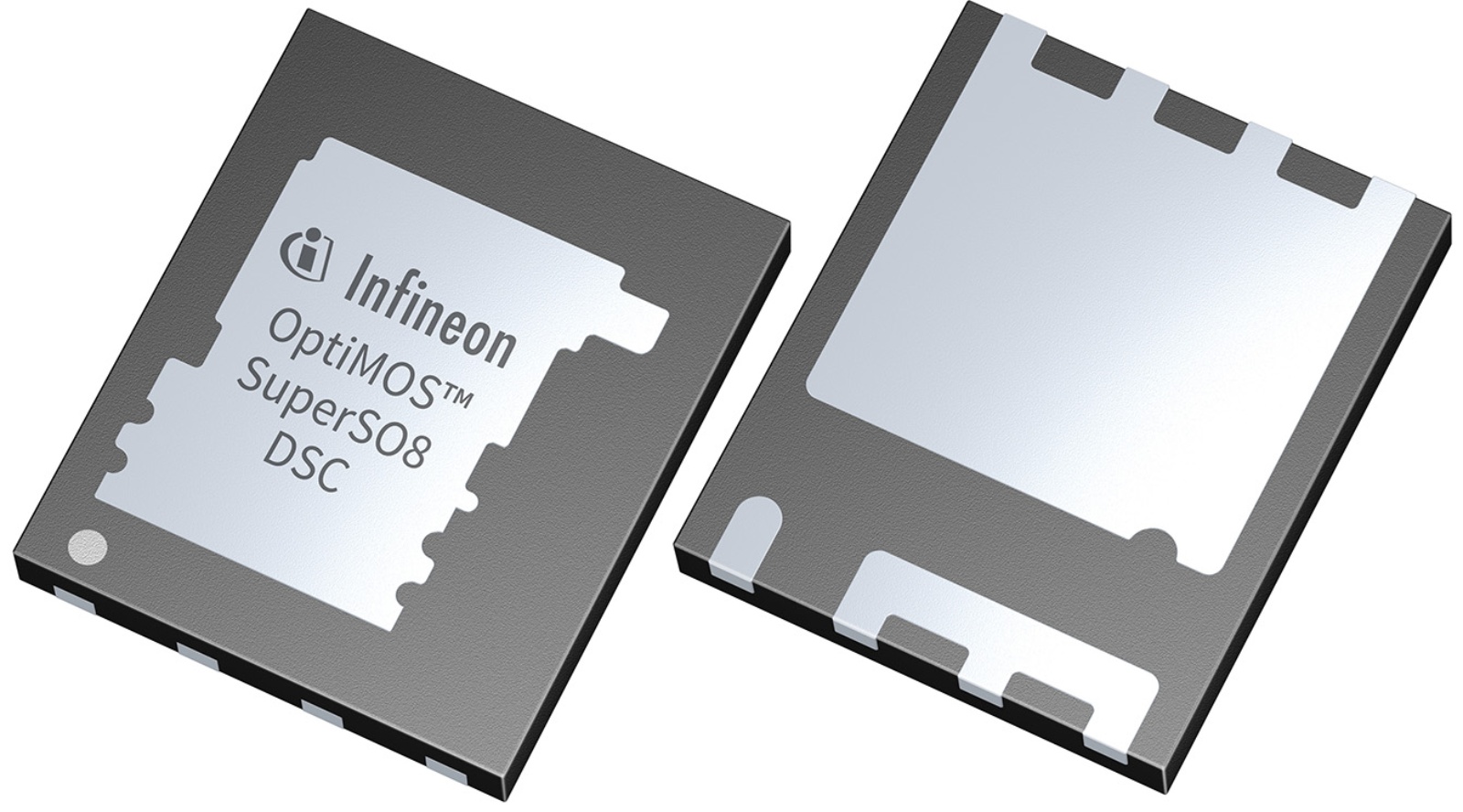
Luckily, I then found the solution to the problem in the shape of the Infineon SuperCool MOSFET packages. These feature a cooling pad on top, which is thermally as well connected to the chip as the bottom pad used for the solder connections. By contacting these to our aluminium housing with thermally conducting material, I could remove the heat without routing it through the PCB, which is not built for the task. And I did not have to compromise on any electrical characteristics, as the chip itself is one of the OptiMOS 5 family that offers excellent performance parameters.
In this way, I was able to pave the way for our custom inverters' design, although many additional design tricks and cutting-edge parts were necessary to bring its performance to the point where it is today. Nonetheless, it was less than nine months from the moment I joined until the redesigned inverter ran tests at 100A – 2.5 times the current of its original design goal. That demonstrated an awesome team effort and showed that quality engineering does not have to take ages if the company structure allows it!
A perfect fit: that's how Megi describes her experience as a Robotics Engineer at arculus. Learn more about how she was impressed with arculus full robotics solution — from mechanics to software and even the fleet manager.
Hey Megi, welcome! Can you start by telling us what made you want to work at arculus as a Robotics Engineer?
I really like manufacturing, automation, and, especially, I'm interested in robotics. So when I discovered arculus, it was actually a perfect match. What I also find really exciting about the company is the scope of our product, because we do a complete development of the mobile robots — mechanics, electronics, software, functions, and even the fleet manager. That truly impressed me, and so I wanted to become a part of it.
And what does a typical working day look like for you?
My morning starts with the daily. It is a brief meeting where the whole team gets together, and we reflect on what each of us did the day before. And then we talk about the plans for the day. After that, I continue working on my tasks. On average, it takes me three days to complete each task, which is usually implementing a new feature. That means reading code and writing code, as well as testing in a simulation. We are now very lucky that we have this test area directly in the office, so I am also constantly running some tests with the real robot driving around the space.
Megi working in our in-house robot test area
How would you describe the arculus culture?
For me, the arculus culture is for sure about commitment. I really appreciate the feeling that we all share the same goal: making really great robots, and we all work towards that goal as a team. With that also comes the transparency and openness, which I truly like. It makes me feel responsible for the work I do and gives me the certainty that others appreciate and recognize my effort.
What has arculus taught you so far?
That would be a very, very long answer (laughs). I've been learning every day from my teammates, who are really great. But apart from the technical things, I find fascinating what our team leads and management are doing. I'm slowly understanding how challenging it is to make this whole thing happen, and I think that they all do a really good job.